
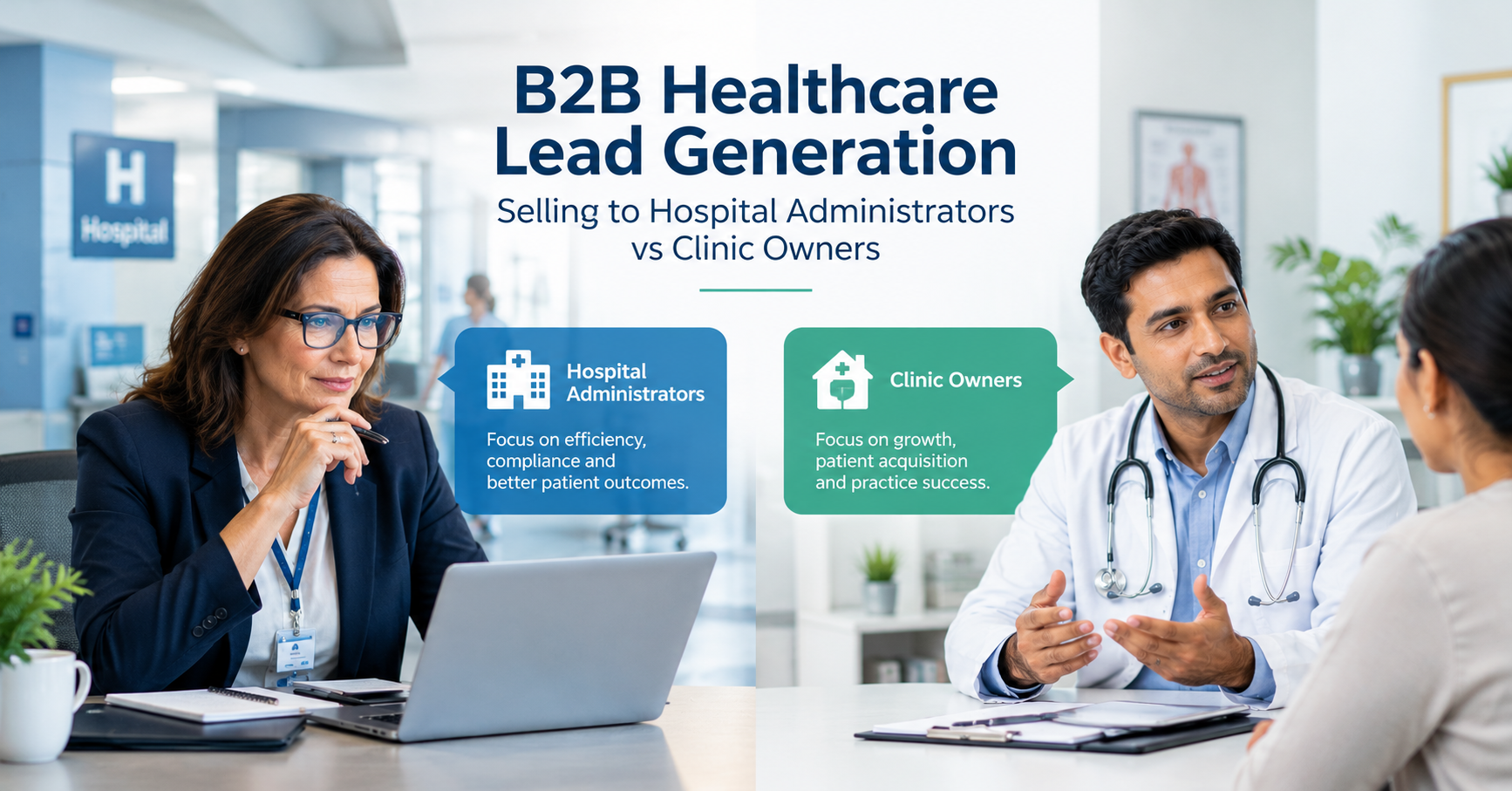
A hospital and a neighborhood clinic may both need the same healthcare solution. But what convinces one to buy it may have very little to do with what matters to the other.
A hospital may need approval from clinical, technical, procurement, and finance teams before moving forward. A clinic owner may weigh the same solution against daily operational demands, affordability, and implementation time. Approach both with the same message, and you risk missing what matters to each buyer.
This is where B2B healthcare lead generation needs a more considered approach. Finding potential customers is only the first step. Understanding how their organizations operate, who influences the decision, and what makes a solution relevant is what makes outreach meaningful.
What makes B2B healthcare lead generation different?
Healthcare purchasing decisions can affect clinical workflows, patient experience, staff responsibilities, budgets, and regulatory obligations. For a company selling healthcare software, equipment, supplies, or professional services, that makes prospecting more complex.
Buyers also hold different priorities. A clinical leader may focus on patient care, an IT team on integration and security, and procurement on vendor terms. Timing matters too: busy teams respond when a problem is real and current, not simply because an email arrived. Effective lead generation accounts for these differences from the start.
Why does healthcare buyer segmentation matter?
Healthcare buyer segmentation means grouping prospects by how they buy, not only by location, size, or specialty. A more useful approach looks at:
- Organization type: hospitals, multispecialty clinics, independent practices, and diagnostic centers
- Operational scale: departments, locations, staff, and services
- Business need: the clinical, administrative, or operational challenge your solution addresses
- Buying authority: who evaluates, recommends, approves, and implements
- Purchasing context: budget, procurement requirements, and capacity to implement
Here’s how the two segments compare:
Hospital administrators | Clinic owners | |
Who decides | Usually a group, with the administrator as sponsor or gatekeeper | Often the owner or practice manager directly |
Decision process | Structured, with several departments involved | Often shorter, with fewer people |
Main concerns | Clinical value, cost against alternatives, fit with existing systems, risk | Cost, time saved, ease of adoption, effect on patients and staff |
Best message focus | A clear problem statement they can take to their team | A direct, practical benefit |
This is a general picture. Country, organization size, and ownership all change it.
How do hospital administrators make buying decisions?
Hospital administrators help evaluate operational requirements, coordinate departments, and manage budgets, but they rarely decide alone. In many hospitals, particularly in the US, new purchases go through a cross-functional review, often called a value analysis committee, and purchasing may also follow group contracts.
What’s reviewed depends on what’s being bought. A patient management platform, for example, may involve:
- Hospital administration to assess operational requirements
- Clinical department heads to weigh workflow and patient-care implications
- IT and information security to review integration, access, and data protection
- Procurement to assess vendors and contract terms
- Finance to review costs and budgets
Medical equipment may also need input from clinical engineering or technical teams.
When you’re selling to hospital administrators, understand this structure before you begin outreach. A generic pitch to an administrator may go nowhere if the real concern sits with the clinical or technical team. A stronger approach ties your solution to a clear hospital priority and prepares material on integration, security, and implementation for the people who will evaluate them. The aim is a conversation that can move across the buying group, not one contact asked to approve everything. An account-based approach helps here, because it engages several stakeholders at the same hospital with one consistent message.
How do clinic owners make buying decisions?
In an independent clinic, the owner often decides directly. In a larger group, a practice administrator or managing partner usually leads, with input from physicians. Where a management company or health system is involved, buying may sit elsewhere entirely. Your first job is finding out which situation you’re in.
Owners’ priorities tend to be close to daily operations. They ask:
- Will this save time or reduce administrative work?
- How easily can staff learn it?
- Does the price fit the practice’s budget?
- How will implementation affect appointments and existing workflows?
- Can it support the clinic as it grows?
A practice manager or senior practitioner may also influence the decision, particularly when the solution changes how the clinic runs. The front desk is rarely the buyer, so reaching the right person matters more than reaching many.
How should outreach differ for each buyer type?
For hospital administrators: open with the operational problem and who it affects, offer a short summary their team can review, and invite a conversation rather than a decision.
“We help hospital teams reduce [specific problem]. If it’s useful, I can send a one-page summary your team can look over.”
For clinic owners: name one relevant problem in a sentence or two, be clear about how little effort is involved, and suggest a short call.
“Running a practice leaves little time for [specific task]. We help clinics handle it with minimal setup. Would a short call be worth your time?”
In both cases, check that the message names a problem the reader actually has. Healthcare buyers notice when it doesn’t. And plan your follow-ups before you send, since busy administrators and owners rarely reply to a first message.
What compliance considerations apply to healthcare outreach?
Cold email is regulated, and the rules depend on where your prospect is based:
- United States: the FTC’s CAN-SPAM guidance makes no exception for business-to-business email. Messages need accurate sender details and a clear way to opt out, and opt-out requests must be honored within 10 business days.
- Canada: CASL generally requires consent, express or implied, before you send commercial messages.
- UK and EU: rules differ by recipient. In the UK, business addresses of companies are treated differently from individuals, but data protection duties still apply. Sole traders and some partnerships are treated like individuals, which can matter for small clinics.
Beyond email law:
- Keep patient information out of outreach. Never include it or ask for it in a cold message.
- Be accurate about what you offer. Buyers will check.
- Be ready for privacy questions. If your product touches patient data, buyers in the US often ask about HIPAA and business associate agreements early.
This is general guidance, not legal advice. Have a qualified adviser review your approach for the markets you sell into.
How do you build a healthcare lead generation strategy?
- Segment your market. Separate hospitals, clinics and other groups by how they buy.
- Define an ideal customer profile for each segment, including who decides and who influences, and agree on what makes a lead qualified.
- Build verified contact lists that reach the right person, not just any person at the organization.
- Write separate messages for each segment, using the sector’s own language. Our cold email outreach and LinkedIn lead generation work is built around this.
- Protect deliverability and stay compliant before you send anything.
- Review results with your sales team and adjust targeting and messaging, so sales and marketing judge lead quality the same way.
Choosing an outside team to run this? Our guide on how to choose a B2B appointment setting partner you can trust covers the questions to ask first.
How does Brandacy approach B2B healthcare lead generation?
At Brandacy, we work as an extension of your team. Our process suits teams selling into healthcare, where getting the buying structure right matters most. We start with your buyers and your ideal customer profile, then research and verify decision-makers by organization type, location, and size.
Through our B2B lead generation and appointment setting service, outreach runs across email, phone, and LinkedIn as one sequence. Before a meeting is booked, we check company fit, a need you can serve, and decision-making authority; polite interest alone doesn’t qualify. Separate, warmed sending domains protect your main domain, and reporting covers replies, qualified meetings, and pipeline value rather than raw send counts.
If you’d like to talk it through, book a discovery call. It’s thirty minutes, with no pitch and no pressure, and we’ll start by asking about your buyers and your sales team.
Frequently Asked Questions
Who makes purchasing decisions in a hospital?
It’s usually a group, not one person. Many hospitals use a committee of clinicians, administrators, supply chain, finance, and risk specialists, and purchasing may also follow group contracts. The hospital administrator is often a sponsor or gatekeeper in that process.
Who should I contact at a clinic?
In an independent clinic, the owner is the best point of contact. In a larger group, it’s usually the practice administrator or managing partner. If a management company is involved, you may need to reach both the clinic and the management team.
Can I use the same message for hospitals and clinics?
It’s better not to. Hospital buyers usually need something they can share with a committee, while clinic owners respond to short, practical messages. Segmenting lets you speak to each group’s real concerns.
What rules apply to cold email in healthcare B2B?
They depend on the prospect’s country. The US allows business cold email with accurate details and an easy opt-out; Canada generally needs consent, and the UK and EU treat companies and individuals differently. Check with a qualified adviser for the markets you target.