
The sales director had barely opened the CRM before rejecting the latest batch of leads.
“Wrong companies. No clear buying intent. Half of them aren’t ready to talk to us.”
Across the table, the marketing manager saw a very different picture. His reports showed the campaign had performed well. It reached people in the target industries, brought visitors to the website, and drove a high volume of downloads of a guide the team had researched extensively. Several prospects had engaged with multiple emails, and their lead scores had crossed the threshold marketing and sales had agreed on.
“So what exactly makes them unqualified?” marketing asked.
From the sales side, none of the conversations revealed a clear business need or an imminent reason to buy. From marketing’s side, the prospects matched the target audience and had shown enough interest to warrant a conversation.
Neither team was necessarily wrong. They were judging the same leads against different expectations.
This scene illustrates a pattern we often see in B2B outbound: marketing and sales defining “qualified” differently.-
This is the real problem behind the MQL vs. SQL debate. Marketing may measure whether a prospect deserves further attention; sales may judge whether that prospect is ready for a sales conversation. When those two definitions are blurred, every rejected lead becomes an argument, and every campaign report becomes harder to trust.
The solution starts with understanding what each qualification stage is actually supposed to tell you. This guide explains the difference between MQLs and SQLs, why sales and marketing disagree about lead quality, and how to agree on qualification criteria that work for both teams.
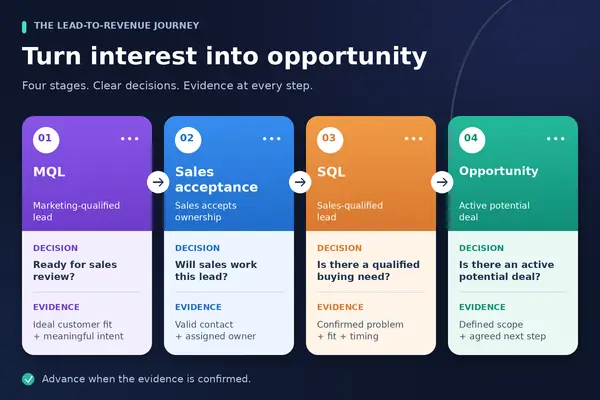
Quick answer: An MQL is a lead that meets marketing’s agreed criteria for fit and engagement and deserves the next step of follow-up. An SQL is a lead that sales has assessed, with more evidence about the prospect’s situation, and agreed to pursue. They are different decisions made at different stages, so each needs its own written criteria.
What Is the Difference Between MQLs and SQLs?
Back in the meeting, the marketing manager opened the campaign report. The sales director pulled up the call notes. Both documents contained useful information, but they answered different questions.
A marketing-qualified lead (MQL) is a prospect who meets agreed criteria for fit and engagement and is considered ready for the next stage of follow-up. Depending on the business, that may mean targeted nurturing, a sales development conversation, or a direct handoff to sales.
A sales-qualified lead (SQL) is a prospect that sales has assessed and considers suitable for continued sales engagement based on the team’s qualification criteria.
The exact definitions vary between businesses. What matters is that the stages reflect distinct decisions, not just CRM labels.
Consider a technology company selling software to logistics businesses. An operations manager at a suitable company downloads a guide about reducing delivery delays. That person might qualify as an MQL if the company meets its criteria. But the download alone does not establish that the company has an active problem, is exploring solutions, or wants to speak with a vendor.
If a subsequent conversation reveals that the company is struggling with delivery visibility and actively evaluating ways to improve it, the prospect may meet the SQL criteria.
The difference is not that marketing found a bad lead and sales magically made it good. It is that the second assessment has more evidence about the prospect’s situation.
Why Do Sales and Marketing Disagree on Lead Quality?
Return to that meeting. When the teams compared their assumptions, three problems began to emerge.
First, engagement had become a substitute for buying intent.
A prospect who downloads three reports may be researching a problem, gathering information for a colleague, or simply learning about the industry. Engagement is useful evidence, but it does not automatically establish purchase readiness.
Second, the target audience was too broad.
A company could operate in the right industry and have the right headcount yet lack the particular problem the service solves. Marketing had measured whether the prospect looked like a potential customer; sales was discovering whether there was a relevant opportunity.
Third, nobody had clearly defined the handoff.
Marketing believed crossing a scoring threshold meant “sales should follow up.” Sales interpreted “qualified” as “there is a credible opportunity to progress.” Neither team had explicitly agreed on the difference.
This is not merely a communication problem. Gartner’s research on improving lead qualification argues that simple models such as BANT (budget, authority, need, timing) are not well suited to early-stage leads in complex technology sales and proposes a fit, openness, need, and engagement (FONE) model instead. Prospects may not have a confirmed budget or purchasing timeline when they first engage.
Demanding complete buying certainty too early can exclude promising opportunities. Treating every sign of interest as sales readiness creates the opposite problem.
The goal is to distinguish a promising prospect from one ready for the next specific step.
What Makes a Lead Qualified?
The sales director revisited the rejected leads. Instead of asking whether they were “good” or “bad,” the teams began asking three more useful questions.
Does the prospect fit?
Is the company within the target market in terms of industry, size, geography, business model, and other relevant requirements? Does the contact have a role connected to the problem or buying process?
Is there a relevant need?
Has the prospect shown a credible connection to a problem the business can solve? This evidence might come from a direct conversation, a stated business priority, or a specific request, not simply a content download.
What should happen next?
Does the prospect need more education, an initial discovery conversation, or a more direct sales discussion? Is there enough evidence to justify the proposed next step?
These questions build on the qualification principle explained in our article on what makes a B2B lead qualified [add link once the article is live]: a useful assessment considers fit, need, and the prospect’s ability to influence a buying decision. The third question above turns that assessment into action.
A lead does not always need a confirmed budget and purchase date to be worth pursuing. But the team should be clear about what is known, what remains uncertain, and which next action makes sense.
At Brandacy, we apply a similar test before a meeting reaches a client’s sales team: fit against the client’s ideal customer profile, a need the client can serve, and the authority to act on it. Polite interest alone does not qualify.
Which Lead Scoring Criteria Should Teams Use?
Once the teams agreed on the questions, they looked at the scoring model itself.
Their mistake had not necessarily been using lead scoring. It was treating the score as a final verdict instead of one input into a qualification decision.
A practical lead scoring model should consider several dimensions:
Criterion | What to assess | What it helps establish |
Company fit | Industry, size, location, business model | Whether the business matches the target market |
Contact relevance | Role, responsibilities, influence | Whether the person is connected to the problem or decision |
Business need | Stated challenge, objective, or priority | Whether there is a credible reason to explore a solution |
Engagement | Relevant website visits, content interactions, enquiries | Whether the prospect is showing interest |
Buying context | Evaluation activity, stakeholders, process, timing where known | How sales should approach the next conversation |
Salesforce’s Account Engagement documentation distinguishes scoring, which measures prospect activity and engagement, from grading, which assesses how closely a prospect matches the desired customer profile. Used together, they provide a more complete picture than either measure alone.
Teams should also avoid assigning arbitrary importance to every interaction. A pricing inquiry may warrant more attention than a general content download, but its significance depends on the offering and buying journey. The model should reflect actual business priorities and be reviewed against what happens after handoff.
How Can Sales and Marketing Align on Lead Qualification?
The meeting changed when the marketing manager stopped defending the campaign total and the sales director stopped treating every rejection as proof of poor targeting.
They agreed to establish a shared process.
- First, define the ideal customer profile together. Sales contributes what it learns from discovery calls and opportunities; marketing contributes audience, campaign, and engagement data.
- Second, document the MQL and SQL definitions. Specify which criteria trigger a handoff, what information sales should receive, and what constitutes acceptance, rejection, or continued nurturing.
- Third, make feedback specific. “Bad lead” tells marketing almost nothing. “Company is outside our target segment,” “no relevant need identified,” and “contact has no connection to the buying process” point to different actions.
- Finally, review the criteria regularly. A scoring model should evolve as the company learns which prospect characteristics and behaviors are associated with meaningful sales conversations.
For businesses using account-based marketing, this alignment is particularly important: marketing and sales need a shared view of which accounts matter, which stakeholders to engage, and what signals justify a more personalized approach. Brandacy’s account-based marketing service explains this account-focused approach.
How Can Teams Improve Lead Quality and Conversion Rates?
The teams returned to the rejected leads, not to reopen the argument, but to learn from them.
They grouped the rejections by reason and looked for patterns. Were the leads consistently outside the target market? Did they fit but lack a clear need? Were promising prospects being passed to sales before they were ready? Or were qualified prospects being rejected because follow-up happened too late or lacked context?
They then reviewed the measures that could reveal where the process was breaking down:
- MQL-to-SQL conversion: Are marketing-qualified leads being accepted by sales?
- SQL-to-opportunity conversion: Do sales-qualified leads progress into credible opportunities?
- Meeting-to-opportunity conversion: Are the conversations producing commercially relevant next steps?
- Rejection reasons: Which qualification criteria are most often missing?
No single metric tells the whole story. A low MQL-to-SQL rate might indicate weak targeting, an unrealistic scoring threshold, unclear definitions, or inconsistent sales follow-up. The team needs the reasons behind the number before deciding what to change.
Gartner’s 2026 guidance on MQLs also argues that MQLs should help identify sales-ready buyers or reveal where demand generation needs improvement, rather than serve as a standalone measure of marketing success.
Lead volume matters only in context. The objective is to create a dependable path from initial interest to meaningful sales conversations and, ultimately, viable opportunities.
Who Should Decide Whether a Lead Is Qualified?
So, who was right in the original meeting?
Marketing was right that engagement and audience fit could justify further attention. Sales was right that neither automatically proved a prospect was ready to buy. The failure was expecting one team’s definition to cover every stage of the buyer’s journey.
Marketing should not define qualification in isolation, and sales should not reject leads without recording why. Both teams should agree on the criteria, own their part of the process, and use outcomes to improve the model.
For teams that want research, outreach, qualification, and handoff run as one system, Brandacy’s B2B lead generation and appointment setting service builds target lists to the client’s ICP and confirms fit, need, and authority before a meeting is booked. To talk through where qualified leads are slipping away, book a call.
The next time sales says a lead was junk and marketing insists it was qualified, resist the urge to settle the argument by choosing a side.
Ask a better question: qualified for what, at which stage, and based on what evidence?
That is where sales and marketing alignment begins, and where a disputed lead can become useful feedback rather than another reason the teams distrust each other.
Frequently Asked Questions
What is the difference between an MQL and an SQL?
A marketing-qualified lead (MQL) meets marketing’s agreed criteria for further attention, while a sales-qualified lead (SQL) has been assessed against the criteria for active sales engagement. An MQL may need further nurturing or research; an SQL has sufficient evidence to justify the next sales step. The exact criteria should reflect the company’s target customers and sales process.
Why does sales reject marketing-qualified leads?
Sales may reject MQLs because the company is outside the target market, the contact is not relevant to the buying process, no clear business need has been established, or the prospect is not ready for direct sales engagement. Rejection can also reveal unclear qualification criteria or inconsistent follow-up. Recording a specific rejection reason helps marketing improve targeting and lead scoring.
How do you improve MQL-to-SQL conversion rates?
Start by reviewing which MQLs sales accept and reject, then group rejection reasons into patterns such as poor company fit, weak buying signals, missing need, or timing. Refine qualification criteria, distinguish engagement from purchase intent, and agree on a clear handoff process. Measure changes over time rather than assuming that a higher conversion rate automatically means better revenue outcomes.
What criteria should be used to qualify a B2B lead?
No. These details may be unknown early in the buying journey. Fit, a credible need, and access to relevant stakeholders may justify further discovery.
Can a lead be an MQL without being ready to buy?
Yes. An MQL can be a suitable potential customer who has shown relevant engagement but is not yet ready for a sales conversation. The appropriate next step may be further research, educational content, or nurturing. This is why marketing qualification should not automatically be treated as proof of immediate purchase intent.
Who should decide whether a lead is qualified: sales or marketing?
Sales and marketing should agree on qualification criteria together. Marketing contributes audience, acquisition, and engagement insights; sales contributes evidence from prospect conversations and opportunity progression. Marketing can manage the initial qualification process, while sales evaluates leads against the shared handoff criteria. Both teams should review outcomes and update the agreement regularly.
What is a good MQL-to-SQL conversion rate?
There is no universal MQL-to-SQL conversion rate that guarantees healthy pipeline performance. Results vary by industry, sales cycle, lead source, and how you define MQLs and SQLs. Businesses should establish a reliable baseline, compare like-for-like periods and channels, and assess conversion alongside opportunity creation and revenue outcomes rather than relying on a generic benchmark.
How often should sales and marketing review lead qualification criteria?
Review qualification criteria regularly, such as monthly during a new campaign or process rollout, and less frequently once the process is stable. Revisit them sooner if rejection patterns change, target markets shift, or MQL-to-SQL and SQL-to-opportunity conversion deteriorate. The aim is to keep the criteria aligned with actual buyer behavior and sales outcomes.