
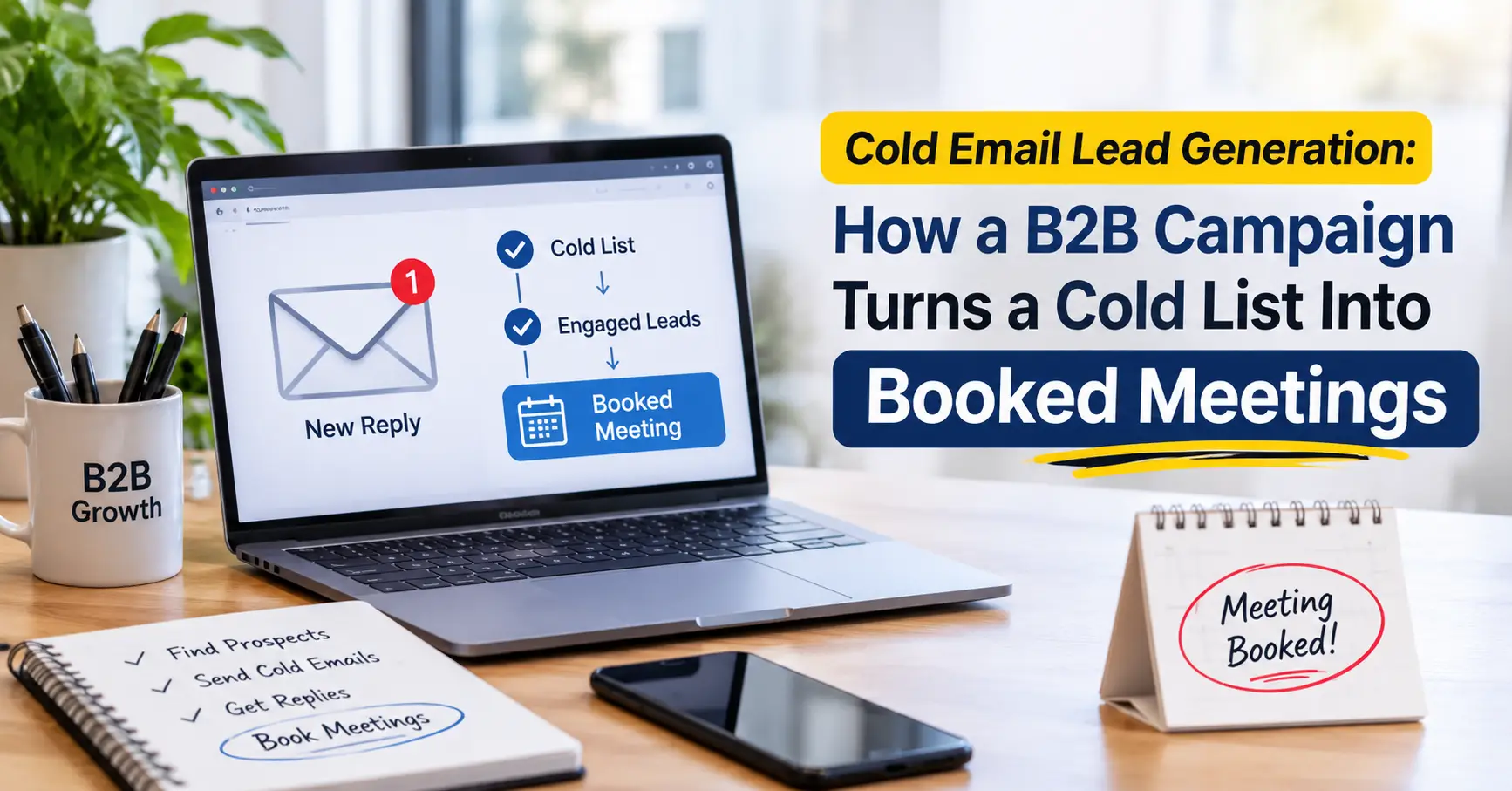
Cold email lead generation is the process of reaching businesses that have not previously interacted with your company and turning relevant contacts into sales conversations. It involves more than finding email addresses and sending messages. A successful campaign connects account research, verified contact data, reliable sending infrastructure, relevant messaging, and timely follow-ups to create qualified sales opportunities.
For B2B companies, the value lies in reaching decision-makers who may need a product or service but have not yet considered the business offering it. This article explains how cold email lead generation works, from identifying the right prospects to qualifying replies and booking meetings with potential buyers.
What Is Cold Email Lead Generation?
Cold email lead generation uses targeted emails to introduce a business, product, or service to potential customers with no prior relationship to the sender. The aim is to start a relevant business conversation, not simply to increase the number of emails sent.
It differs from traditional email marketing, which generally communicates with people who have subscribed, opted in, or already interacted with a business. Cold outreach starts earlier in the buying journey, when the prospect may not know the company or its offering.
Consider a cybersecurity provider looking to work with mid-sized financial services businesses. Rather than sending a generic pitch to a large database, it identifies companies with relevant security requirements, finds the people responsible for IT or risk management, and introduces a service that addresses a specific business concern.
If the contact responds with interest, the conversation can move towards a discovery call. That progression, from a researched prospect to a qualified sales conversation, is what makes cold email lead generation a structured acquisition channel.
How Does Cold Email Lead Generation Work, Step by Step?
A B2B cold email lead generation process typically follows this sequence:
ICP definition → Account research → Contact verification → Sending setup → Email sequence → Reply handling → Lead qualification → Booked meeting
Each stage affects the next. A poorly selected prospect list cannot be rescued by clever copy, and a positive reply has little commercial value if it never reaches the right person on the sales team.
1. Define the ideal customer profile
Start by identifying the businesses most likely to benefit from the offer. An ideal customer profile (ICP) describes the companies a campaign should target, using factors such as industry, company size, location, revenue range, business model, and operational needs.
Commercial fit matters as much as firmographic fit. A company might operate in the right industry but have no immediate need, suitable budget, or internal capacity to adopt the solution.
2. Identify target accounts and decision-makers
Build a list of companies that match the ICP, then identify the people responsible for the relevant business function or purchasing decision.
For example, a provider of finance automation software may need to reach finance directors, controllers, or CFOs. The right contact depends on the company’s size and how it makes purchasing decisions.
3. Build and verify the contact list
Collect relevant business contact details, verify email addresses, remove duplicates, and record useful company and role information. Include a research note explaining why each account or contact belongs in the campaign.
4. Prepare the sending infrastructure
Configure sending domains, mailboxes, authentication, and campaign tools before outreach begins. Test the setup and monitor its performance as sending activity develops.
5. Write and send the sequence
Create an initial email and a considered follow-up sequence. Each message should give the recipient a clear reason to engage and make the next step easy.
6. Manage replies and qualify interest
Respond to genuine inquiries, handle objections appropriately, recognize referrals, and respect opt-out requests. Assess whether interested contacts fit the agreed qualification criteria.
7. Book and hand over the meeting
Once a prospect is qualified and agrees to a conversation, schedule the meeting and share the relevant context with the sales representative. This should include the company’s background, the contact’s role, the original outreach, the response, and the stated business need.
How Do You Build and Verify a B2B Prospect List?
The quality of the prospect list directly affects campaign relevance. A database containing thousands of contacts is not necessarily useful if the businesses do not fit the offer or the people listed have no involvement in the relevant decision.
A practical list-building process includes:
- Set account criteria: Define target industries, company sizes, locations, and business models.
- Research potential accounts: Use company websites, professional networks, business directories, public announcements, and reliable data providers.
- Identify relevant business signals: Hiring activity, expansion, new leadership, funding, or operational changes may indicate a need worth exploring.
- Map the right stakeholders: Select contacts based on their responsibilities and influence over the problem being addressed.
- Verify and maintain records: Check email validity, remove duplicates, update outdated details, and document the source of contact information.
Email verification reduces avoidable delivery failures, but it does not confirm whether a contact is interested or commercially suitable. A valid email address is only one part of a useful prospect record.
The account selection process deserves particular attention when targeting larger businesses, where several people may influence a purchase. Brandacy’s guide to B2B outbound sales and account targeting offers further context on selecting companies and relevant stakeholders.
What Infrastructure Does a Cold Email Campaign Need?
Even a well-researched campaign can struggle if its sending setup is poorly configured. Before launching, businesses should establish reliable infrastructure and monitor it throughout the campaign.
The main components include:
- Sending domains and mailboxes: Plan how you’ll send campaign emails. Dedicated sending domains may help separate outreach activity from essential business communication, but they do not remove the need for responsible sending practices.
- Email authentication: Configure SPF, DKIM, and DMARC correctly for the domains and services being used. These protocols help receiving providers verify the sender.
- Campaign platform: Use a system that supports sequence management, reply tracking, suppression lists, and performance monitoring.
- Controlled sending volume: Avoid sudden increases in sending activity. Build a consistent pattern and adjust based on delivery errors, recipient feedback, and provider responses.
- Ongoing monitoring: Review bounces, spam complaints, authentication, and domain reputation rather than treating setup as a one-time task.
Google’s official email sender guidelines explain authentication and sending requirements for messages reaching personal Gmail accounts, including additional requirements for bulk senders. Businesses should also review the requirements of other mailbox providers and the laws applicable to their target markets.
For a closer look at the technical considerations, read Brandacy’s guide to cold email deliverability and domain reputation.
How Should Replies Be Handled and Qualified?
A reply is not automatically a sales-qualified lead. A recipient might express interest, ask a question, refer a colleague, decline the offer, or ask that you stop emailing. The response process should distinguish between these outcomes.
A simple reply-handling system can use the following categories:
- Interested: The prospect wants to explore the offering or understand how it could address a business need.
- Needs more information: The prospect has a question that should be answered before suggesting a meeting.
- Referral: The contact identifies another person who handles the relevant decision.
- Not now: There may be a future opportunity, but the timing is unsuitable.
- Not interested or opt-out: Close the conversation and respect the request. Remove the contact from further outreach where required.
For interested contacts, qualification should establish whether the company fits the ICP, whether there is a relevant business need, and whether the contact is involved in or connected to the decision. Timing, budget, and implementation requirements may also be relevant, depending on the offer.
The handoff should preserve this information. A sales representative should know why they contacted the prospect, what prompted the response, and what the prospect has already shared. This avoids an awkward first meeting where the prospect has to repeat the same information.
Brandacy’s B2B lead generation and appointment setting service brings outreach, lead qualification, and meeting coordination together to help sales teams focus on relevant conversations. For businesses targeting a defined group of high-value accounts, account-based marketing can complement this approach with more coordinated engagement.
Which Metrics Show a Campaign Is Working?
Campaign performance should be measured by the quality of the opportunities created, not just the volume of emails sent.
|
Metric |
What it tells you |
|
Bounce rate |
Whether contact data or sending practices need attention |
|
Positive reply rate |
Whether the message is generating relevant interest |
|
Qualified lead rate |
Whether responses meet the campaign’s qualification criteria |
|
Meetings booked |
Whether outreach is creating sales conversations |
|
Meeting show rate |
Whether booked prospects are attending |
|
Opportunity conversion |
Whether meetings are progressing into genuine sales opportunities |
|
Opt-outs and spam complaints |
Whether targeting, relevance, or sending practices need review |
Open rates should be interpreted cautiously because privacy features and automated activity can make them unreliable. Positive replies, qualified meetings, and sales opportunities offer a more meaningful view of commercial progress.
An illustrative funnel, not a performance benchmark: Suppose a campaign contacts 500 researched prospects. Twenty respond, eight express genuine interest, and four meet the agreed qualification criteria. The campaign has generated four qualified opportunities from that group. These figures are hypothetical and do not represent Brandacy results.
Review performance by industry, account type, job role, message angle, and sequence step. This helps identify which parts of the campaign are producing relevant conversations and where adjustments are needed.
How Long Does Cold Email Lead Generation Take to Produce Meetings?
There is no universal timeline. The time required depends on prospect data quality, the readiness of the sending infrastructure, the offer’s complexity, the target audience, and the length of the sales cycle.
A business with a clearly defined ICP, verified contacts, and a properly configured sending setup may be ready to test sooner than one starting from scratch. New infrastructure needs preparation and monitoring. Once outreach begins, prospects may respond to the first email or a later follow-up, while some opportunities require additional discussion before a meeting is appropriate.
Rather than promise a fixed number of meetings within a set number of days, assess progress in stages:
- Are the right companies and decision-makers being reached?
- Are the emails generating relevant responses?
- Are interested contacts meeting the qualification criteria?
- Are qualified prospects attending meetings and progressing into sales opportunities?
Follow-ups are an important part of this process, but they should add context or make it easier for the recipient to respond. Brandacy’s guide to B2B cold email outreach follow-ups explains how to structure them without relying on repetitive reminders.
Turn Cold Email Activity Into a Qualified B2B Pipeline
Cold email lead generation works when the steps are connected. Account research determines who enters the campaign. Verified contact data and sound infrastructure support reliable delivery. Relevant messaging gives prospects a reason to respond, while thoughtful qualification determines whether a response should become a sales meeting.
The process also needs to reflect the target business. A campaign for a specialist B2B service may require a different audience, message, and qualification standard from one designed for a broad software market.
Brandacy’s cold email outreach services combine prospect targeting, sending infrastructure, email sequences, and campaign management to help businesses build a more consistent path to relevant B2B conversations. If your team is planning a campaign or looking to improve an existing one, book a call with Brandacy to discuss your target market and outreach requirements.
Frequently Asked Questions
What is the 30/30/50 rule for cold emails?
The 30/30/50 rule is mentioned in some cold email discussions as a way to divide attention between campaign elements. However, the industry has no universally accepted definition of this formula. Rather than treating it as a fixed rule, focus on the fundamentals: a relevant audience, a credible message, reliable sending practices, and a follow-up process that respects the recipient.
How do you send 10,000 emails per day?
Sending 10,000 emails a day is not a sensible starting target for most B2B campaigns. Large-scale sending requires appropriate infrastructure, authenticated domains, reliable contact data, careful volume management, and the ability to handle replies and opt-outs. It must also comply with mailbox-provider requirements and applicable laws.
More volume does not automatically mean more qualified opportunities. Businesses should confirm a campaign is relevant and working properly before deciding whether greater scale is justified.
Are B2B cold emails legal?
B2B cold email is permitted in some circumstances, but the rules depend on the recipient’s location, the type of contact, the message, and the applicable privacy and electronic marketing laws. Requirements differ across markets, including the United States, the United Kingdom, and the European Union. Businesses conducting international outreach should review the rules in each target market, identify themselves accurately, and respect opt-out requests.
How do you generate leads through cold email?
Define an ideal customer profile, research suitable companies, identify relevant decision-makers, and verify their contact details. Prepare authenticated sending infrastructure, write concise emails around a credible business need, and use relevant follow-ups. Handle replies promptly, qualify genuine interest, and track the meetings and opportunities generated.
Does cold email lead generation work in 2026?
Yes. Cold email can still support B2B lead generation in 2026 when it is targeted, relevant, technically sound, and responsibly managed. Generic mass outreach is more likely to waste resources and damage sender reputation. The emphasis should be on reaching the right people and creating useful sales conversations, not simply increasing sending volume.
How many follow-up emails should a B2B cold email sequence include?
There is no fixed number that works for every audience or offer. A short, carefully planned sequence is generally preferable to repeatedly contacting someone without adding anything useful. Each follow-up should provide context, address a relevant point, or make it easier for the prospect to respond. Stop when the recipient opts out, declines, or otherwise indicates that further contact is unwelcome.
What makes a prospect a qualified lead in cold email outreach?
A prospect becomes a qualified lead when there is a reasonable fit between the business, the offering, and a potential need. Qualification usually considers company profile, relevant business challenge, contact’s role or influence, timing, and practical suitability. A positive reply alone does not establish qualification. The agreed criteria should be clear before a campaign begins so the sales and outreach teams assess opportunities consistently.
What should a good first cold email include?
A good first email should identify the sender, establish why the message is relevant to the recipient, communicate one clear business benefit or observation, and end with a simple next step. It should be specific enough to show that the sender understands the prospect’s business, but concise enough to read quickly. Avoid generic praise, lengthy company introductions, exaggerated claims, and several competing calls to action.