
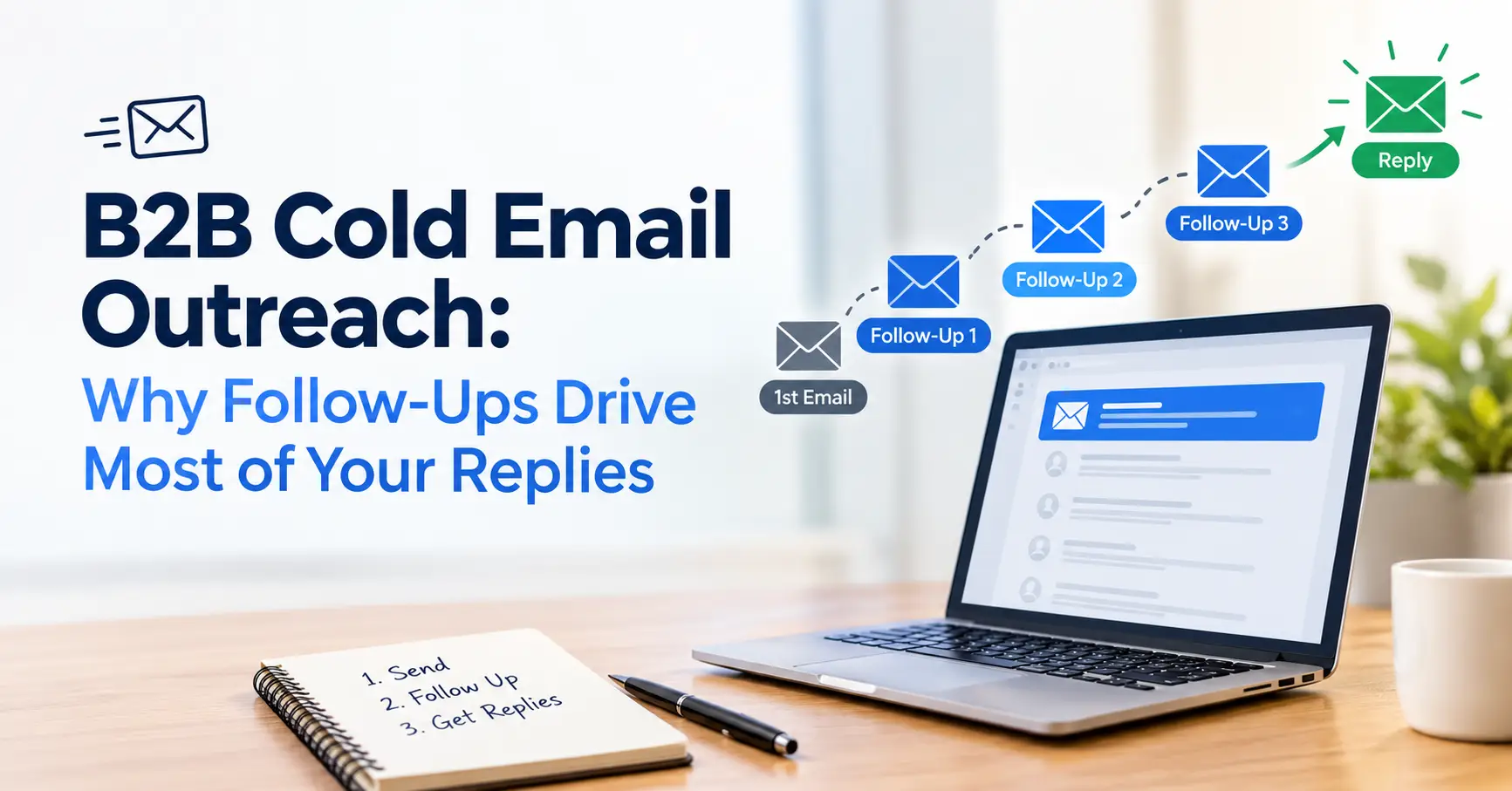
B2B cold email outreach works best when every message gives the right prospect a reason to respond. The first email introduces a potential business opportunity. A thoughtful follow-up builds on that introduction, adds useful context, and makes it easier to start a conversation. The goal is consistent, relevant communication, not a long sequence of reminders.
A prospect might be interested in your offer and still not respond to your first email. They may be dealing with a more urgent priority, evaluating other options, or may have missed your message. For sales teams, silence does not always mean rejection.
What matters is what you send next.
Why Is Follow-Up Important in B2B Cold Email Outreach?
The first email establishes relevance. Follow-ups give you more chances to demonstrate it.
According to Belkins’ 2026 B2B sales follow-up study, which analyzed more than 7.5 million emails from its 2025 outreach operations, follow-up emails accounted for 58.6% of replies across the sequences studied. The first email accounted for the remaining 41.4%, yet it still had the highest reply rate of any single step. Belkins also reported that more than half of its email-sourced meetings came from the third email onward.
The distinction matters. The first email is the strongest individual message, but most replies arrive later in the sequence. These figures come from Belkins’ own campaign data, so they are a useful industry example rather than a guaranteed result for every B2B campaign. They do show why judging outreach after one email gives an incomplete picture.
Consider a company selling software that reduces manual reporting in logistics operations. Its first email introduces the idea. A follow-up could explain how inconsistent reporting affects visibility across locations. A later message might ask whether improving reporting is a priority this quarter.
The offer stays consistent, but each email gives the prospect a different reason to engage.
That is the purpose of a good cold email follow-up sequence: build on the original message instead of repeating it.
How Many Follow-Up Emails Should You Send?
For many B2B cold email campaigns, three to four follow-ups after the initial email is a sensible starting point. That makes four to five emails in total, in line with the three to five steps Belkins’ data points to. Beyond the fifth step, returns diminish quickly. The right number still depends on your offer, audience, sales cycle, and the responses you receive.
Use this sequence as a starting framework:
Touchpoint | Suggested timing | Purpose |
Initial email | Day 1 | Introduce a relevant business problem and a clear next step. |
Follow-up 1 | Day 4 | Reconnect and reinforce the original relevance. |
Follow-up 2 | Day 8 | Add a useful insight, example, or different angle. |
Follow-up 3 | Day 13 | Ask a focused question about the prospect’s priorities. |
Final follow-up | Day 20 | Close the loop politely. |
These intervals are practical starting points, not a universal formula. Test them against your audience and campaign results.
More emails do not automatically create more opportunities. A later message that brings a genuinely new perspective can be worthwhile. Another message that simply says “Just checking in” rarely adds value.
Stop automated follow-ups when a prospect replies, opts out, asks not to be contacted, or enters an active sales conversation. Respect clear disinterest instead of treating every contact as someone who needs one more reminder.
How Long Should You Wait Between Follow-Up Emails?
Give prospects enough time to read, consider, and respond before sending another message.
An initial gap of three to five days is a reasonable starting point for many B2B campaigns, with sends scheduled for weekdays. Later follow-ups can be spaced further apart, particularly when the offer involves a considered purchase or a longer sales cycle.
Timing should reflect the situation:
- A timely business trigger: A company expanding into a new market may have an immediate need, so a shorter interval may be appropriate.
- A considered purchase: Enterprise software or consulting services may require internal discussions, so a longer interval can make sense.
- A stated timeline: If a prospect asks you to reconnect next quarter, follow that timeline rather than continuing an automated sequence.
The goal is to stay recognizable without becoming a distraction. Monitor replies and negative feedback, then adjust the schedule based on what your audience tells you.
What Should You Include in a Cold Email Follow-Up?
An effective cold email follow-up is concise, specific, and easy to answer. It should reference the original message while giving the prospect a fresh reason to engage.
Here is an example of a mid-sequence follow-up (Follow-up 3 in the table above).
Subject: Reporting across locations
Hi Alex,
When reporting is manual across locations, delays tend to surface late, and comparing performance between sites is hard. Is improving reporting visibility a priority for your team this quarter?
Best,
[Your Name]
This message gives Alex enough context, links the offer to a relevant business challenge, and asks one focused question. It also leaves room for the prospect to say the issue is not a current priority. Keep your follow-ups in the same thread as the original email, and avoid adding a fake “Re:” to a new message, because a misleading subject line damages trust before the email is opened.
When writing your own follow-ups, focus on three things:
- Relevance: Connect the message to the prospect’s role, company, or likely business challenge.
- New context: Add an observation, example, or question that moves the conversation forward.
- A clear next step: Make it easy to reply without immediately demanding a lengthy meeting.
Personalization should go beyond inserting a name or company name. A credible observation about the prospect’s business is more useful than a generic compliment.
When Should You Add Another Channel?
If four or five emails have brought no reply, another email may not be the best next step. Belkins’ study found LinkedIn reply rates above 7%, and a short LinkedIn message that refers to your earlier emails gives the prospect a fresh way in. That figure comes from a different channel and campaign structure, so it does not directly compare to per-step email reply rates. It does explain why many teams pair email with LinkedIn lead generation instead of extending an email sequence indefinitely.
Keep your LinkedIn message brief and relevant, and do not copy your email word for word.
How to Create an Effective B2B Cold Email Follow-Up Sequence
A good sequence starts before you send the first email. It depends on knowing whom you are contacting and why your offer might matter to them.
- Choose the right accounts and contacts. Identify companies that fit your ideal customer profile, then find people whose responsibilities connect to the problem you solve. A relevant offer sent to the wrong person can still go nowhere.
- Give every message a distinct purpose. The first email introduces the opportunity. A follow-up might clarify the business challenge, another could offer a useful example, and a later message can ask whether the issue is a current priority. Each touchpoint should add something.
- Keep the sequence concise. Write for busy professionals scanning their inbox between meetings. Remove lengthy introductions, unnecessary product details, and multiple calls to action.
- Coordinate outreach across your team. Track replies, meetings, opt-outs, and active conversations. If multiple sales representatives contact the same account, coordinate their activity to avoid duplication.
- Learn from campaign performance. If a particular message generates relevant replies, examine what makes it useful. If a sequence produces complaints or negative responses, revisit the audience, message, and timing.
A sequence should help your team learn what resonates with potential buyers. It should not run on autopilot regardless of what prospects tell you.
What Common Follow-Up Mistakes Should You Avoid?
Follow-up becomes counterproductive when persistence replaces relevance.
Avoid these common mistakes:
- Repeating the same message. A follow-up should offer a new reason to engage, not just restate the original pitch.
- Using pressure or guilt. Asking why someone has ignored you can damage trust before a conversation begins.
- Following up without account research. More messages will not fix a mismatch between your offer and the prospect’s needs.
- Making every email a sales pitch. A relevant observation or focused question can be more useful than another list of product features.
- Ignoring replies and opt-outs. Automated outreach must stop or change when a prospect’s response requires it.
- Scaling without monitoring deliverability. Watch bounce patterns, spam complaints, and provider responses. More follow-ups are of little use if emails are not reaching their intended recipients.
The principle is straightforward: respect the prospect’s time and protect your business’s credibility.
How Can You Measure B2B Cold Email Outreach Performance?
B2B email outreach aims to create relevant sales conversations, not maximize the number of messages sent.
Track these measures to understand whether your sequence is working:
Metric | What it tells you |
Positive reply rate | Whether prospects are showing genuine interest. |
Meeting-booking rate | Whether outreach is creating sales conversations. |
Qualified opportunity rate | Whether those conversations involve businesses with a relevant need and a good fit. |
Bounce Rate | Whether contact data or sending practices need attention. |
Opt-outs and spam complaints | Whether your outreach is unwanted or needs adjustment. |
Reply rate alone can be misleading. A campaign may generate many responses that have little connection to your offer, while a smaller number of relevant replies may lead to better sales opportunities.
Review performance by account segment, audience, message angle, and sequence step. Where practical, compare similar groups and change one or two variables at a time. This makes it easier to identify which adjustments are helping.
Treat open rates with caution, because privacy features and automated activity can distort them. Positive replies, qualified meetings, and opportunities give a more meaningful picture of commercial impact.
Turn Follow-Ups Into Better B2B Sales Conversations
Successful B2B cold email outreach starts with the right accounts, reaches the right people, and follows up with a reason to engage. The first email opens the conversation. Follow-up messages should establish relevance and help determine whether a genuine business opportunity exists.
Brandacy helps businesses build focused outbound programs through cold email outreach, B2B lead generation and appointment setting, and account-based marketing. By aligning account selection with relevant outreach, businesses can make follow-up a purposeful part of their sales process.
If your team wants to improve its prospecting approach and create more relevant sales conversations, book a call with Brandacy to discuss your goals.
Frequently Asked Questions
What is B2B cold email outreach?
B2B cold email outreach is the process of contacting potential business customers who have not previously engaged with your company. The goal is to introduce a relevant solution and start a conversation with someone who may influence or make a buying decision.
Why is follow-up important in cold email outreach?
Follow-up gives prospects more opportunities to assess your message and its relevance. In Belkins’ data, follow-up emails accounted for most replies. A useful follow-up adds new context, clarifies a business problem, or helps you determine whether the prospect wants a conversation.
How many follow-up emails should you send?
Three to four follow-ups after the initial email, so four to five emails in total, is a reasonable starting point for many B2B campaigns. The right number depends on the audience, offer, sales cycle, and prospect response. Stop when someone replies, opts out, or indicates that further contact is inappropriate.
How long should you wait before sending a cold email follow-up?
A gap of around three to five days before the first follow-up is a practical starting point. Adjust the timing to the prospect’s business context, any stated timeline, and your campaign results.
What should a cold email follow-up include?
A cold email follow-up should briefly reference the original message, add a relevant insight or question, and offer a clear next step. Keep it concise and avoid repeating the same pitch.
When should you switch from email to another channel?
If four or five well-targeted emails have produced no reply, consider a short, relevant LinkedIn message instead of adding more emails. Refer to your earlier outreach so the message has context.
How do you improve B2B cold email outreach results?
Start with well-matched target accounts and contacts, personalize messages around credible business needs, give each follow-up a distinct purpose, and measure positive replies and qualified opportunities. Monitor deliverability and respect opt-outs throughout the campaign.